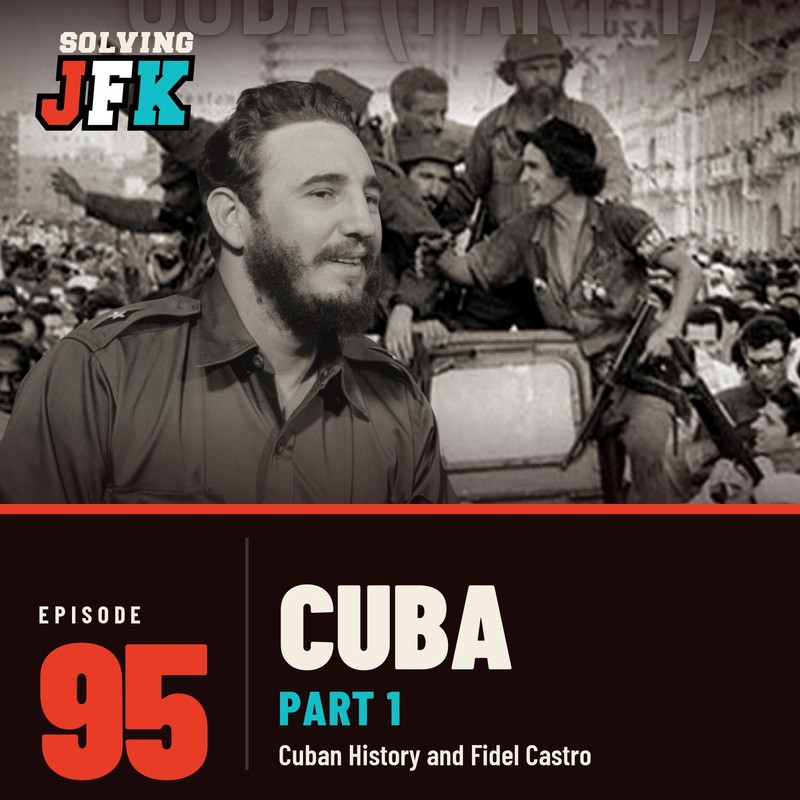
We are now a little more than halfway through Season 3 of Solving JFK. This season, we ask the question: if Lee Harvey Oswald didn’t kill President Kennedy, then who did? We’ve covered the Secret Service, the FBI and J. Edgar Hoover, Lyndon Johnson, the Mafia, Israel, and the Soviet Union. We’re now getting into part of the podcast I’ve really been looking forward to: over the remainder of Season 3, we’re going to analyze the four potential culprits we have not yet covered: Fidel Castro, Cuban Exiles, the CIA, and the Military. First up is Cuba and it’s revolutionary dictator, Fidel Castro.
While it’s tempting to just dive in to the Bay of Pigs or to start with Castro taking power, we are going to go back a little farther in Cuban history in this episode - with an eye towards understanding the context in which Fidel Castro became the revolutionary leader, and then dictator, of Cuba.
Remember the Maine
After Christopher Columbus landed in Cuba in 1492, Spain controlled Cuba and subjugated the natives for hundreds of years, with a brief window where Britain controlled Cuba in the mid 1700s, only to give it back to Spain in exchange for Florida.1 Then, between 1868 and 1898 there were a series of rebellions by native Cubans who wanted independence from Spain, which led to the deaths of approximately 49,000 Cubans and 126,000 Spanish soldiers.2
In American newspapers the struggle of the Cuban people against the Spanish government was viewed favorably, with Americans seeing it as similar to the Revolutionary War against the British.3 Unbeknownst to the American public, the US Government secretly offered to buy Cuba from Spain, but Spain declined the offer.4
Eventually, there was a new autonomous Cuban military government set up in 1897 to compete with the Spanish government for authority. In January of 1898, in response to Spanish loyalists in Cuba rioting and destroying printing presses of papers that were critical of Spain, the American battleship – USS Maine – was sent to Havana.5
On February 15, 1898, just a few days after arriving in Cuba, the Maine was destroyed by an explosion, killing 268 crewmembers. There was initially confusion about the cause of the explosion. The internal investigations by the US found that Spain bombed the ship, while the Spanish investigation determined that it was caused by an accidental spontaneous coal fire onboard.6
The USS Maine incident was sensationalized by New York newspapers that devoted 8 pages to the Maine incident in every paper for a week following the event, fueling speculation that the Maine was bombed by the Spanish. This led to the famous battle cry: “Remember the Maine! To hell with Spain!”7
On April 20, 1898, the United States Congress passed a joint resolution acknowledging Cuban independence from Spain.8 That resolution contained the Teller Amendment, which said that the US would not QUOTE "exercise sovereignty, jurisdiction, or control over said island" and promised "to leave the government and control of the island to its people."9 After just 16 weeks, largely in response to the sinking of the Maine, the United States defeated the Spanish in what U.S. Ambassador in London, John Hay, called “the splendid little war.”10
Platt Amendment
The official government of the Cuban republic began on May 20, 1902.11 Despite the Teller Amendment’s promise that the United States would not annex Cuba, the US changed course by adopting the Platt Amendment shortly after that. The Platt Amendment gave the American Army broad control to stabilize Cuba as needed. It also prohibited Cuba from signing treaties with other nations or going in to public debt. Most importantly, the Platt Amendment gave the United States a permanent American Naval base in Cuba at Guantanamo Bay.12 All of this American power over Cuba was written into Cuba’s Constitution.
The United States was not shy about using its authority under the Platt Amendment. It intervened in Cuban affairs in 1906, 1912, 1917 and 1920, usually under the auspices of putting down political rebellions to maintain the peace.13
After two terms from a corrupt President, Gerardo Machado from 1924 to 1932, the Cuban military demanded Machado’s removal. 14 There was a brief provisional government after Machado stepped down. But, on September 4, 1933, Sergeant Fulgencio Batista and five others arrested the army chief of staff at gunpoint and took control of the army. The new government, led by Ramon Grau San Martin, proclaimed a social revolution and deemed the Constitutional provisions giving power to America to be invalid.15
Grau to Batista
From 1934 until 1939, Fulgencio Batista ruled Cuba through puppet presidents.16 Then, in 1940, Batista, himself, was elected President of Cuba. He was not able to run for re-election in 1944 due to the Cuban Constitution barring consecutive terms.17 Instead, Batista put up a chosen successor to run, and the Cuban people voted for the other candidate – Ramon Grau San Martin. Grau’s government became the most corrupt one since Cuban independence, with Grau overseeing fifty political assassinations inside Cuba in one year.18
Grau was succeeded in 1948 by his labor minister, Carlos Prio Socarras.19 Much like his successor, Prio’s administration was corrupt. For example, when Grau was being investigated for stealing 187 million pesos from the government, all of the documents, under watch by Prio’s government, disappeared.20 Prio also acquired 16 homes while he was president and left the office with $90 Million dollars.21 Meanwhile, under Prio, Cuba struggled with economic problems, labor unrest, and gang violence.
In 1952, Fulgencio Batista was once again on the ballot for president in Cuba’s June 1st election. But, rather than seeing how he fared at the ballot box, Batista staged a coup against Prio – taking power on March 10th, 1952. The Coup was over within hours. Batista then cancelled the scheduled election and suspended the Cuban Constitution. Within two weeks, the United States formally recognized Batista’s government.22
It’s not all that surprising that the US would acknowledge Batista. As a practical matter, the Cuban economy was controlled by American interests. Americans owned 40% of sugar production, 75% of Cuban farmland, and 90% of essential services. During Batista’s term, he solidified ties with the United States, severed diplomatic relations with the Soviet Union, suppressed trade unions, and persecuted Cuban socialist groups.23
So, by 1952, Cuba had experienced a bloody series of battles for independence against Spain, three decades of de facto American control, a military revolution in 1933 (by Batista and others) that led to corrupt civilian governments. And, then a second coup by Batista again in 1952. This was the Cuba in which Fidel Castro came of age.
Young Castro
Fidel Castro was born on August 13, 1926 in Southeastern Cuba. His father was drafted into the Spanish Army in 1895 and forced to fight against Cuba’s independence.24 Fidel’s mother was his dad’s household servant and mistress. When he was just 6 years old, Fidel was sent away to live with his teacher, and later to go to boarding school, in Santiago de Cuba.25
In 1945, at 19 years old, Castro began studying law at the University of Havana. In 1947, Castro volunteered for the Ortodoxo party in a political campaign against Carlos Prio. In 1952, Fidel Castro himself was a candidate for the Cuban House of Representatives in the election scheduled for June that year. Of course, that election never happened after Batista seized power in March of 1952. At first, Castro filed lawsuits against Batista.26 But, when his attempts to follow the rule of law failed to hold Batista accountable, Castro adapted to more violent tactics.
Before he was a candidate for office, Fidel Castro was no stranger to violence. Cuba was plagued by street gangs in the 1940s. In December of 1946, to win favor with rival gang leaders, Castro shot Leonel Gomez in the back while hiding behind a stone wall near the University sports stadium. Gomez survived the gunshot.27
In 1948, Florentino Aspillaga, Sr was a student at the University of Havana at the same time as Fidel Castro. He later claimed that he watched from behind a tree as Fidel murdered another student – Manolo Castro (no relation). Manolo’s friends had previously tried to kill Fidel. So, he got revenge. Fidel was investigated for the murder, but never charged. After he ascended to power, Fidel named a science building at the University of Havana after Manolo.28
Five months after the Manolo Castro murder, according to Fidel’s friend, Max Lesnick, Castro was implicated, but never charged, in the murder of a University of Havana police officer.29
Moncada Barracks
Castro’s violent past combined with the 1952 Batista coup was the perfect mix to motivate Castro to start a revolution against the Batista regime. After all, Fidel’s dreams of being a politician were now impossible within the system. On July 26, 1953, Castro led 136 rebels in an attack on the Moncada Barracks in Santiago de Cuba. 9 of the rebels died in combat and 42 were arrested and executed. Castro was arrested within days, along with most of the others.30
He was ultimately sentenced to 15 years in prison.31 Castro served his time at the notorious Isle of Pines, which had no running water, little food, and filthy living conditions.32 But, Castro and the other rebels were placed in the nicer hospital section of the prison together, which meant that Castro and his men were able to plan the next phase of the revolution from behind the prison walls.33
When Castro was freed in 1955 under a general amnesty for political prisoners, he had only served 22 months of his 15 year sentence. Upon his return from the Isle of Pines, Castro put the revolutionary plans he had been developing in prison into action. He called his movement the 26th of July Movement, based on the day of the attack on the Moncada Barracks.34
Preparing for Revolution
Castro returned to Havana and spoke out against Batista to the press and on radio, which led to Castro being surveilled by Batista’s government. Later, in 1955, Fidel and his brother, Raul, fled Cuba for Mexico after Batista increased the intensity of his crackdown on dissent.35 In Mexico, the Castros met a doctor from Argentina named Ernesto Che Guevara, who was, according to Fidel, QUOTE “a more advanced revolutionary than I was.” Castro also met Spaniard, Alberto Bayo, who became the lead trainer for Castro’s men on guerilla warfare tactics.36
Castro could see the revolutionary potential of his small, dedicated military force, but the reality was that he needed money and weapons to be able to wage a real guerilla war against Batista. One of the sources of funding for Castro’s revolution, in particular for the purchase of the Granma, Castro’s yacht, was Carlos Prio – the former Cuban president who had been ousted by Batista in March of 1952. Prio raised money for Castro in Florida and was later prosecuted in the United States for violating the Neutrality Act in 1958 by helping Castro.37
On November 25th, 1956, Castro and 81 armed revolutionaries secretly boarded the Granma and set sail for Cuba at 2am, departing from the coastal town of Tuxpan, Mexico. The plan was for 100 of Castro’s revolutionaries in Cuba to meet up with the Granma in 5 days when it landed. But, the Granma landed two days late, which led to the revolutionaries dispersing or being discovered, which put the Cuban military on high alert for the arrival of Castro and his rebels.38
When the Granma finally landed, it crashed into a sandbar a mile away from its intended landing point, in a mangrove swamp. Because of the boat being stuck and the Cuban military being in hot pursuit, most of the equipment and supplies had to be left on the Granma so that the men could focus on getting to shore. They took what they could and left the rest on the boat. When Castro and his crew disembarked from the ship, they were spotted by the Cuban Coast Guard and forced to flee into the Sierra Maestra mountains.39
Only 19 of Castro’s 81 rebels who traveled from Mexico made it with him into the mountains. In addition to Fidel, these survivors included Raul Castro and Che Guevara. The rebels began conducting small raids of nearby army posts to get weapons. After about a month in the mountains, they took over the Cuban Army outpost there. After the fighting, they provided medical treatment to Batista’s soldiers who were wounded, but they executed the local land company overseer. Fidel’s rebels suffered no casualties in the battle, which provided them with much needed supplies and weapons.40
After this successful first battle, which came to be known as the Battle of La Plata, Castro’s revolutionary force grew from 19 to 200 by July of 1957. Castro divided his army in to three groups – each led by Fidel, Raul, and Che Guevera, respectively. At this point, the troops began to receive supplies from supporters throughout Cuba and abroad.41
Sturgis Helps Castro
One of those supporters was American adventurer and mercenary, Frank Sturgis, who had moved to Miami in 1957 and, through his uncle’s Cuban wife, befriended former Cuban president, Carlos Prio, who was living in exile in Miami. Prio, like Castro, wanted to see the overthrow of Batista – though they did not share the same goals for how a post-Batista Cuba would look. At Prio’s request, Frank Sturgis traveled to the Sierra Maestra mountains and offered to train Castro’s troops. Castro accepted his offer of training, but told Sturgis that his more serious need was for weapons and ammunition for the revolution.42
At that point, in an effort to give Castro the help he asked for, Frank Sturgis began running guns to Cuba. He purchased boatloads of weapons and ammo from the Central Intelligence Agency,43 for whom Sturgis became an informant. The CIA was actually hedging its bets about who would control Cuba – backing both anti-Castro and anti-Batista dissidents.44
Mckeown/Ruby Sidebar
The gun running projects led to Sturgis becoming involved with Santos Trafficante.45 And this is where all of that gun running that we were talking about before in previous episodes kicks in to high gear.
You may recall Robert McKeown, the gun runner who was visited by both Jack Ruby and by Oswald (or someone pretending to be Oswald), and before that had befriended Fidel Castro. McKeown was close to Carlos Prio and had a long history with him. By the Fall of 1958, McKeown was transporting weapons from Arkansas and Louisiana to Mexico by boat to be shipped to Castro in Cuba.46
Remember, we also have confirmation from James Beaird, Blaney Mack Johnson, Mary Woodard, Fabian Escalante, and Dr. Werner Teuter that Jack Ruby was running guns to Cuba. If Ruby was doing that, and it looks like he absolutely was, the timeline of when Ruby was running guns directly overlaps with the timeline of when Castro was in need of weapons.47 Indeed, before Batista was ousted, Jack Ruby wrote to the State Department’s Office of Munitions Control requesting permission to negotiate the purchase of firearms and munitions from an Italian firm, according to an Army intelligence report.48
Castro Takes Power
Ok, back to Castro’s rise to power. By the Spring of 1958, Batista’s army was forced to completely withdraw from the Sierra Maestra region, where Castro and his forces controlled a hospital, schools, a printing press, a slaughterhouse, and a land mine making factory. Around the same time, Frank Sturgis came through on his third attempt with a successful air delivery of weapons and ammo from Miami to Castro in the mountains.49
As Castro’s movement became stronger, Batista increased censorship, torture and executions, which only further enflamed the situation. To compound problems for Batista, in March of 1958, the United States imposed an arms embargo on Cuba, suspending delivery of nearly 2,000 rifles that would have gone to Batista’s army.50
After a general strike that was limited to Central and Eastern Cuba, as well as more attacks from Castro, Batista attempted an all-out attack on Castro by bombing the mountain forests and surrounding the rebel bases. But, Castro’s rebels used land mines and surprise ambushes. Many of Batista’s own soldiers deserted and joined Castro’s side.51
Throughout 1958 Castro and his movement wreaked havoc on any interest that was aligned with the Batista government, including American interests. The Freeport Sulphur company had 10 Americans and 2 Canadian civilians kidnapped. 28 American sailors were kidnapped from a bus outside of Guantanamo Bay. Castro eventually released those prisoners within a week to avoid blowback from the United States52, whose CIA was after all, (at least partially) bankrolling his revolution.
In December of 1958, Eisenhower sent a representative to Havana to persuade Batista to resign. But, before Batista could respond to Eisenhower, he had been defeated.53 The final straw for Batista was Che Guevara’s division capturing an armored train filled with weapons and ammo that Batista’s forces desperately needed. Batista fled to the Dominican Republic in the early morning hours of January 1st, 1959.
On January 3rd Che Guevera led the first rebel group into Havana without opposition. Castro arrived in Havana on January 8th and established a new provisional government, naming himself the Prime Minister.54 Once he was in power, Castro dealt out inexact revenge against his enemies. By May 15, 1959, 600 people had been put to death by revolutionary courts.55
The US was one of the first countries to recognize Castro’s government. But, when Castro traveled to America in April of 1959, President Eisenhower refused to meet with him and instead sent Vice President Richard Nixon. Castro disliked Nixon. And Nixon said of Castro, QUOTE "The one fact we can be sure of is that Castro has those indefinable qualities which made him a leader of men. Whatever we may think of him he is going to be a great factor in the development of Cuba and very possibly in Latin American affairs generally. He seems to be sincere. He is either incredibly naive about Communism or under Communist discipline-my guess is the former...His ideas as to how to run a government or an economy are less developed than those of almost any world figure I have met in fifty countries. But because he has the power to lead...we have no choice but at least try to orient him in the right direction.”56
While the brutality of the Batista regime made it easy to support someone who wanted Batista ousted, the reality of how Castro would govern was not clear until he was in power. Many Castro supporters in Cuba expected a free and open democracy. What came to pass was an outright dictatorship.
NEXT TIME ON SOLVING JFK: We analyze the early reaction to Fidel Castro in the United States, through the Bay of Pigs, as we work towards answering the question of whether Cuba was involved in any way in the assassination of President John F. Kennedy.